
CAPTCHA is designed to tell bots from people; yet in the world of automation and testing it is often necessary to bypass this protection. Special CAPTCHA-solving services take on such tasks using a mix of algorithms and human labor.
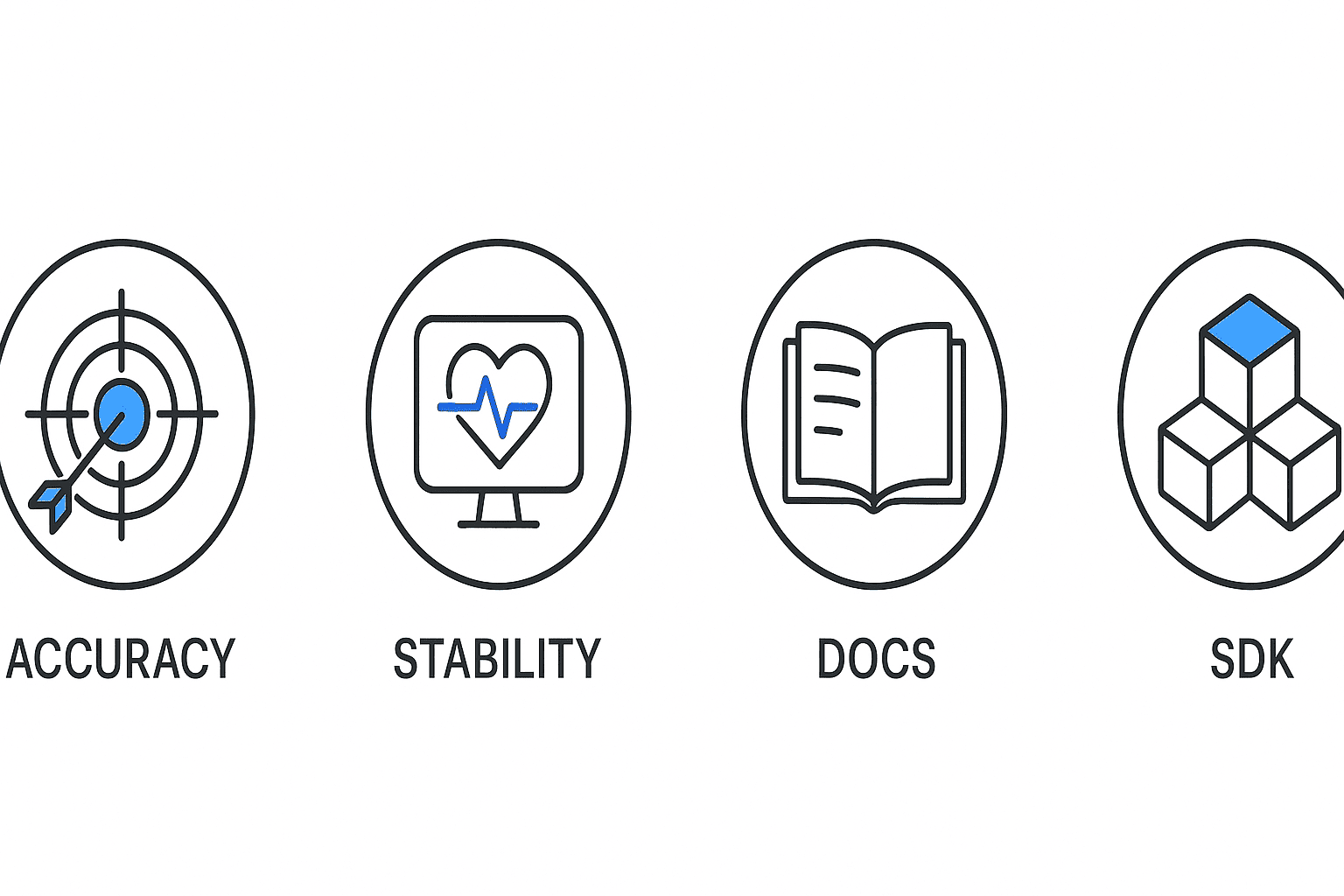
In this article I will compare four popular platforms—2Captcha, SolveCaptcha, AntiCaptcha (AntiGate) and DeathByCaptcha (DBC)—through the lens of testing their APIs with code samples in Python and JavaScript. I will evaluate key criteria: response speed, recognition accuracy, API stability, documentation quality and SDK convenience.
Test Participants: Which CAPTCHA-Solving Services Are We Looking At?
Before diving into the details, let’s briefly examine each platform—its reputation and what it offers.
2Captcha
One of the oldest and largest anti-CAPTCHA services (operating for more than 10 years). CAPTCHAs are solved manually by a vast distributed workforce worldwide for a small fee. This approach guarantees solving virtually any CAPTCHA type, though wait times vary with load.
2Captcha supports an incredibly wide range of CAPTCHAs: from classic text images and every version of Google reCAPTCHA to regional systems (Yandex, VKontakte), image-rotation puzzles and many others. The service provides a convenient HTTP API and browser plug-ins for automatic CAPTCHA solving.
SolveCaptcha
A relatively new player (appeared in 2024/2025) with an ambitious hybrid technology. The service focuses on a combination of neural networks and human effort for high speed: simple CAPTCHAs (distorted text or basic images) are cracked by algorithms in 2–5 seconds, while more complex multi-step tasks are routed straight to humans.
Thus SolveCaptcha aims to win on speed without sacrificing reliability. It positions itself as a “powerful and fast” service capable of solving nearly all CAPTCHA types. An HTTP API (fully protocol-compatible with 2Captcha for painless migration) and a Chrome/Chromium extension are provided.
Declared support covers Google reCAPTCHA (v2, Invisible, v3, Enterprise), hCaptcha, Arkose Labs FunCaptcha, Cloudflare Turnstile, GeeTest, Ruetc.—virtually any CAPTCHA, with claimed success rates of 95–99 %.
AntiCaptcha (AntiGate)
A market veteran operating since 2007. AntiCaptcha relies mainly on real workers rather than AI, similar to 2Captcha. Over the years it has tuned its infrastructure for high throughput and near-continuous availability (claimed uptime 99.99 %).
All common and advanced CAPTCHA types are supported: Google reCAPTCHA v2/v3 (including Enterprise and Invisible), puzzles like GeeTest or Cloudflare Turnstile, FunCaptcha, hCaptcha and more. Integration options include browser extensions (Chrome, Firefox, Safari), ready-made modules for automation tools (iMacros, Puppeteer, Selenium) and a modern JSON API.
A distinctive feature is Custom Tasks: via API you can describe an arbitrary workflow (e.g., a sequence of clicks on a site) and workers will carry it out—going beyond classic CAPTCHA solving. (2Captcha offers something similar but doesn’t promote it widely, apparently due to limited demand.)
DeathByCaptcha (DBC)
An international service with a 15-year history. DBC was among the first to use a hybrid approach—combining OCR algorithms with a 24/7 pool of human decoders. Simple text CAPTCHAs are solved automatically within seconds; tougher ones go to manual operators. This yields about 90 % accuracy on simple CAPTCHAs at first try and up to 99 % after human verification.
DBC supports a broad task set: classic graphic CAPTCHAs, Google reCAPTCHA (including Invisible v2 and v3), audio CAPTCHAs for the visually impaired, hCaptcha, FunCaptcha, GeeTest (v3/v4) and even niche systems like CyberSiara or FriendlyCaptcha. A major advantage is API compatibility: besides its own protocol DBC supports standard 2Captcha-style POST/GET as well as competitor protocols (e.g., AntiCaptcha API).
This means existing code for 2Captcha or AntiCaptcha often works with minimal changes (just swap URL and key). Official SDKs exist for Python, Java, C#, PHP and others. Browser extensions arrived later but are now offered for Chrome and Firefox. Overall DBC is valued for stability and long market presence, though it may add surcharges during peak hours to manage load.
Note: All four services aim to cover the widest possible range of CAPTCHAs. By 2025 their supported lists overlap heavily: Google reCAPTCHA of all versions, hCaptcha, Arkose Labs FunCaptcha, Cloudflare Turnstile, GeeTest, classic text & graphic CAPTCHAs, etc. Practically any CAPTCHA found online can be solved by these platforms.
The differences lie in nuances and extra capabilities: AntiCaptcha’s Custom Tasks and coordinate clicking, 2Captcha’s support for rare local CAPTCHAs, DBC’s audio decoding and cross-protocol support, while SolveCaptcha stresses auto-detection of CAPTCHA type and high speed via neural nets.
Which Metrics Matter for a CAPTCHA-Solving Service?
This test-drive focuses on several key criteria important when choosing a CAPTCHA provider for integration:
1. Solving Speed
How fast the service returns an answer—both for simple tasks (e.g., plain text CAPTCHAs) and more complex ones (reCAPTCHA, puzzle-style). We’ll also look at how services scale under multiple parallel requests.
2. Recognition Accuracy
The percentage of CAPTCHAs solved correctly. All services claim near-maximum accuracy (95–99 %), especially when a human is in the loop. We’ll check real-world correctness and the presence of refund mechanisms for wrong answers.
3. Stability & Reliability
Service uptime, 24/7 API availability, resilience to load spikes. We’ll note declared uptimes (AntiCaptcha claims 99.99 % since 2007) and dig into past large-scale outages.
4. Documentation & Developer Support
Quality of official docs, tutorials, code samples, community activity and tech support responsiveness. We are interested in how easy it is to start with the API, whether ready-made SDKs exist, and how quickly support responds.
5. Integration Convenience (SDKs)
Availability of official libraries for different languages, ease of wiring API into a project, webhook support, compatibility with tools like Selenium/Puppeteer, and other developer-friendly features.
Test Methodology
For each service I executed a typical CAPTCHA-solving task by writing small code fragments in Python and JavaScript. I assessed how easy it was to install and connect the library (or call the API directly), the request/response format, and whether a correct result was obtained. Full quantitative comparison of speed/accuracy would need large-scale testing under identical conditions, so a degree of subjectivity is acknowledged. Note: to repeat these tests you must register with the service and obtain an API key for authorization.
API Integration: Using CAPTCHA-Solving Services in Python and Node.js
All four platforms expose an open API, though formats and approaches differ slightly.
2Captcha CAPTCHA-Solving Service: Simple HTTP API with Polling (Python Example)
2Captcha uses a straightforward two-step HTTP interaction that has become the de-facto anti-CAPTCHA standard:
- in.php — submit a CAPTCHA for solving; receive a task ID.
- res.php — poll for the result using that ID.
There is an official 2captcha-python library, but for clarity we’ll use raw requests. The example below solves Google reCAPTCHA v2 with 2Captcha (you need the site’s public sitekey and the page URL):
import time
import requests

API_KEY = "YOUR_API_KEY"  # your 2Captcha key

IN_URL  = "https://2captcha.com/in.php"
RES_URL = "https://2captcha.com/res.php"

# 1) Submit reCAPTCHA v2 task
payload = {
    "key": API_KEY,
    "method": "userrecaptcha",
    "googlekey": "6Le-wvkSAAAAAPBMRTvw0Q4Muexq9bi0DJwx_mJ-",  # demo sitekey
    "pageurl": "https://www.google.com/recaptcha/api2/demo",
    "json": 1
}

try:
    resp = requests.post(IN_URL, data=payload, timeout=15)
    resp.raise_for_status()
    data = resp.json()
except requests.RequestException as e:
    raise SystemExit(f"Network error while submitting task: {e}")
except ValueError:
    raise SystemExit(f"Invalid JSON on task submit: {resp.text!r}")

if data.get("status") == 1:
    captcha_id = data["request"]
    print(f"Task submitted. ID = {captcha_id}")
else:
    raise SystemExit(f"Submit error: {data}")

# 2) Poll for the answer (every 5 s, up to ~100 s)
result_params = {
    "key": API_KEY,
    "action": "get",
    "id": captcha_id,
    "json": 1
}

captcha_token = None
for attempt in range(20):
    try:
        res = requests.get(RES_URL, params=result_params, timeout=15)
        res.raise_for_status()
        res_data = res.json()
    except requests.RequestException as e:
        raise SystemExit(f"Network error while polling: {e}")
    except ValueError:
        raise SystemExit(f"Invalid JSON while polling: {res.text!r}")

    if res_data.get("status") == 1:
        captcha_token = res_data["request"]  # g-recaptcha-response
        break
    elif res_data.get("request") == "CAPCHA_NOT_READY":
        print(f"Not ready yet... ({attempt+1}/20)")
        time.sleep(5)
    else:
        raise SystemExit(f"Error polling: {res_data}")

if not captcha_token:
    raise SystemExit("Timed out waiting for CAPTCHA solution.")

print("CAPTCHA solved (g-recaptcha-response):", captcha_token)
Most 2Captcha clients follow this logic. Instead of manual polling you can supply a pingback URL so the service calls you when ready. 2Captcha supports many other CAPTCHA types via the method parameter (hcaptcha, base64, etc.). Official docs include multi-language examples; ready libraries exist for Python, Java, C++, PHP, Node.js and more—making integration very straightforward.

Results: On simple image CAPTCHAs 2Captcha typically replies in 7–15 s given enough workers. For complex tasks (e.g., reCAPTCHA v2) average time is ~20 s, though best cases can be 3–5 s and worst up to a minute. Our test returned ~20 s. Variance stems from worker availability.
SolveCaptcha: 2Captcha-Compatible API Focused on Speed (JavaScript Example)
A key benefit of SolveCaptcha is full protocol compatibility with 2Captcha: identical endpoints /in.php and /res.php. Migration often means only changing the domain and API key. The Node.js example (global fetch, Node 18+) submits the same reCAPTCHA task to api.solvecaptcha.com:
'use strict';

const API_KEY = 'YOUR_API_KEY';

function sleep(ms) {
  return new Promise(r => setTimeout(r, ms));
}

async function solveRecaptcha() {
  // 1) Submit task
  const form = new URLSearchParams({
    key:        API_KEY,
    method:     'userrecaptcha',
    googlekey:  '6Le-wvkSAAAAAPBMRTvw0Q4Muexq9bi0DJwx_mJ-',
    pageurl:    'https://www.google.com/recaptcha/api2/demo',
    json:       '1'
  });

  const inRes = await fetch('https://api.solvecaptcha.com/in.php', {
    method: 'POST',
    body:   form,
    signal: AbortSignal.timeout(15000)
  });
  if (!inRes.ok) throw new Error(`HTTP ${inRes.status} on submit`);
  const inData = await inRes.json();
  if (inData.status !== 1) throw new Error(`Submit error: ${JSON.stringify(inData)}`);

  const id = inData.request;
  console.log('Task ID:', id);

  // 2) Poll result
  for (let i = 1; i <= 20; i++) {
    await sleep(5000);
    const res = await fetch(
      `https://api.solvecaptcha.com/res.php?key=${API_KEY}&action=get&id=${id}&json=1`,
      { signal: AbortSignal.timeout(15000) }
    );
    if (!res.ok) throw new Error(`HTTP ${res.status} on poll`);
    const data = await res.json();

    if (data.status === 1) {
      console.log('Solved token:', data.request);
      return data.request;
    }
    if (data.request === 'CAPCHA_NOT_READY') {
      console.log(`Waiting... (${i}/20)`);
      continue;
    }
    throw new Error(`Polling error: ${JSON.stringify(data)}`);
  }
  throw new Error('Timeout waiting for CAPTCHA solution');
}

solveRecaptcha().catch(err => {
  console.error(err);
  process.exit(1);
});
Code is almost identical to the 2Captcha example—only the base URL changes. SolveCaptcha ships libraries for eight languages and browser extensions. Architecture mirrors 2Captcha: submit → poll → retrieve token.
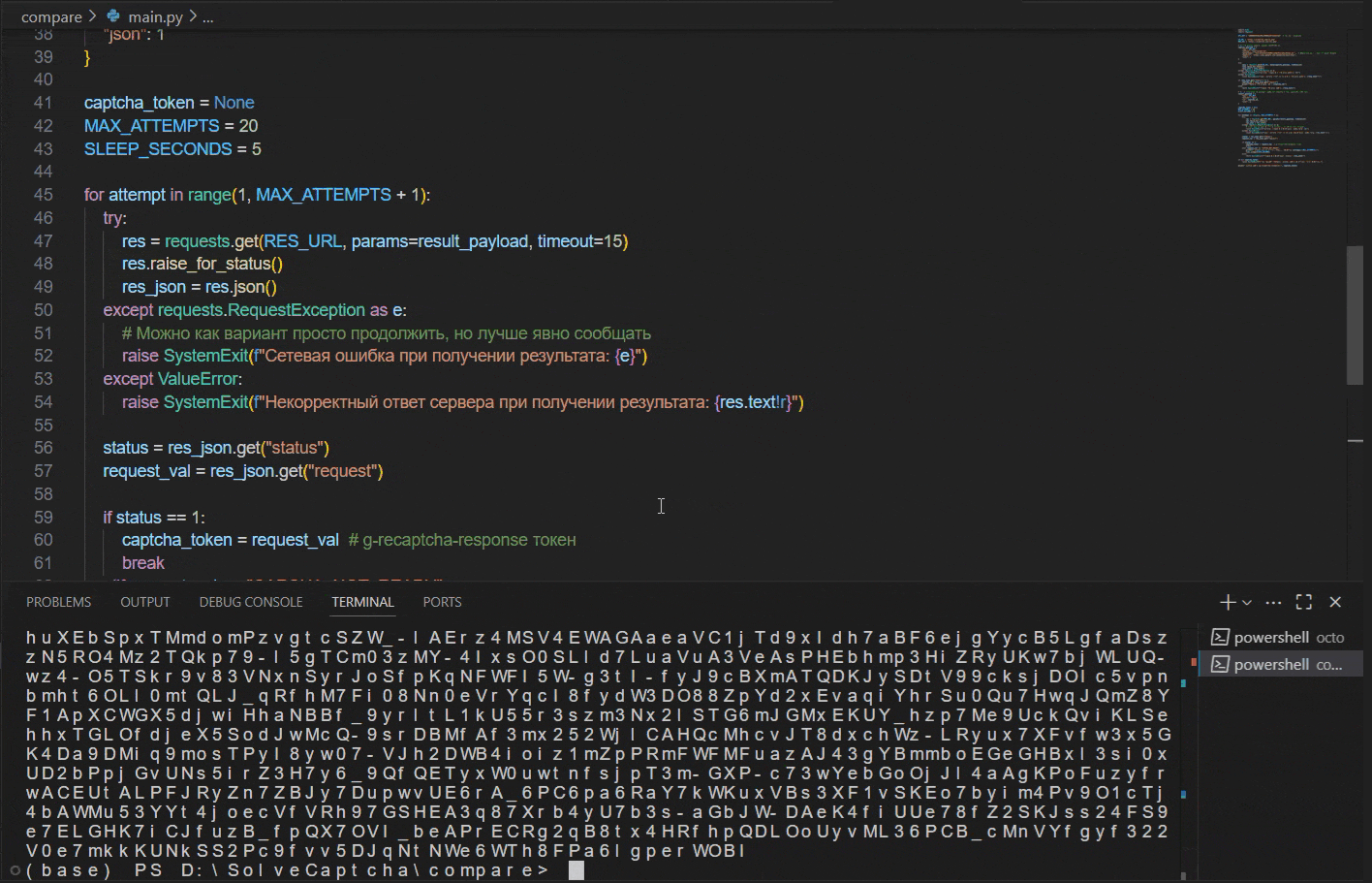
Results: SolveCaptcha markets itself as the fastest service. Neural-net methods can resolve simple image CAPTCHAs in 3–5 s and complex puzzles like reCAPTCHA v2 in ~4–5 s. In our trial the first run returned in ~14 s, the second in 43 s—still faster than typical competitors.
AntiCaptcha: Flexible JSON API with Tasks (Python Example)
AntiCaptcha’s API uses a JSON-RPC style with task objects instead of query strings. Steps:
- Call createTask with a JSON payload describing the CAPTCHA (e.g.,
NoCaptchaTaskProxylessfor reCAPTCHA without proxy). ReceivetaskId. - Poll getTaskResult until status is
"ready"and extract the answer.
Although SDKs are provided, here’s raw JSON interaction solving reCAPTCHA v2 without proxy:
import time, requests
API_KEY = "YOUR_ANTICAPTCHA_KEY"

# 1. Create task
payload = {
    "clientKey": API_KEY,
    "task": {
        "type": "NoCaptchaTaskProxyless",
        "websiteURL": "https://example.com/page/with/recaptcha",
        "websiteKey": "6LfD3PIbAAAAAF9_demo_site_key"
    }
}
task_id = requests.post("https://api.anti-captcha.com/createTask",
                        json=payload).json()
if task_id.get("errorId") != 0:
    raise RuntimeError(f"Task creation error: {task_id}")
task_id = task_id["taskId"]
print("Task ID:", task_id)

# 2. Poll result
for _ in range(20):
    resp = requests.post("https://api.anti-captcha.com/getTaskResult",
                         json={"clientKey": API_KEY, "taskId": task_id}).json()
    if resp.get("status") == "ready":
        token = resp["solution"]["gRecaptchaResponse"]
        print("Solved token:", token)
        break
    print("Processing...")
    time.sleep(3)
else:
    raise RuntimeError("Timeout waiting for CAPTCHA solution")
The JSON format adds structure and allows fine-grained parameters (proxy, User-Agent, cookies, coordinate clicks, etc.). You can dispatch hundreds of tasks in parallel—AntiCaptcha imposes no hard limits.
Results: Speed generally matches 2Captcha: 10–20 s on common CAPTCHAs, sometimes longer. Our test solved reCAPTCHA in ~38 s—slower than SolveCaptcha. Accuracy is very high, though AntiCaptcha lacks an explicit refund method for wrong solutions.
DeathByCaptcha: Multi-Protocol Service with Official SDKs (JavaScript Example)
DeathByCaptcha offers several integration paths. The Token API example below solves reCAPTCHA v2 using global fetch. Authentication can be login/password or authtoken.
'use strict';

const USER = 'DBC_USER';
const PASS = 'DBC_PASS';
const SITEKEY = '6Le-wvkSAAAAAPBMRTvw0Q4Muexq9bi0DJwx_mJ-';
const PAGEURL = 'https://www.google.com/recaptcha/api2/demo';

const sleep = ms => new Promise(r => setTimeout(r, ms));

async function solveRecaptcha() {
  // 1) Create task (type=4 → reCAPTCHA v2)
  const form = new FormData();
  form.append('username', USER);
  form.append('password', PASS);
  form.append('type', '4');
  form.append('token_params', JSON.stringify({ googlekey: SITEKEY, pageurl: PAGEURL }));

  const inRes = await fetch('http://api.dbcapi.me/api/captcha', {
    method: 'POST',
    body: form,
    headers: { Accept: 'application/json' },
    signal: AbortSignal.timeout(20000)
  });
  if (!inRes.ok) throw new Error(`HTTP ${inRes.status} on submit`);
  const inData = await inRes.json();
  const id = inData.captcha;
  console.log('Task ID:', id);

  // 2) Poll result
  for (let i = 0; i < 20; i++) {
    await sleep(5000);
    const res = await fetch(`http://api.dbcapi.me/api/captcha/${id}`, {
      headers: { Accept: 'application/json' },
      signal: AbortSignal.timeout(15000)
    });
    if (!res.ok) throw new Error(`HTTP ${res.status} on poll`);
    const data = await res.json();
    if (data.text) {
      console.log('Solved token:', data.text);
      return data.text;
    }
    console.log(`Waiting... (${i+1}/20)`);
  }
  throw new Error('Timeout waiting for CAPTCHA solution');
}

solveRecaptcha().catch(e => {
  console.error(e);
  process.exit(1);
});

Results: DBC shows average speed. Simple CAPTCHAs 7–10 s (faster if OCR fires). Complex ones 15–30 s—slightly slower than 2Captcha/AntiCaptcha but acceptable. Our test returned ~20 s. DBC may raise prices during peaks to throttle load.
Speed & Performance: Which CAPTCHA-Solving Service Is the Fastest?
One of the main selection criteria is response time—especially when you must solve many CAPTCHAs in a row or in parallel. Up front: on simple tasks (e.g., reading text from an image) all four services are quick—answers usually arrive in 5–15 s. On complex CAPTCHAs (Google reCAPTCHA, Arkose FunCaptcha, etc.) times rise and vary more—typically 10–40 s, worst-case up to a minute. The nuances:
- SolveCaptcha posts the best times on most CAPTCHA types. Thanks to neural nets, simple images fall in 3–5 s; reCAPTCHA v2 averages ≈ 4–5 s. In ideal conditions they cite 2 s for reCAPTCHA v2, but real-world averages are higher. Still, SolveCaptcha is consistently the speed leader.
- 2Captcha & AntiCaptcha sit neck-and-neck. Both rely on large human pools, so latency equals the wait for the first free worker—usually 10–20 s for reCAPTCHA. 2Captcha can occasionally surprise with a 1–3 s answer if a “warmed-up” worker grabs the job instantly; AntiCaptcha markets ≈ 18–40 s for reCAPTCHA, practically the same.
- DeathByCaptcha is slightly slower: reCAPTCHA jobs land around 15–35 s. The pool is smaller, and heavy reliance on manual input adds delay. For simple text images DBC can actually match the leaders (5–10 s) when OCR kicks in.
Bottom line on speed:
SolveCaptcha is the clear winner if every second counts. 2Captcha and AntiCaptcha share second place; DeathByCaptcha trails by a few seconds but remains within a reasonable window for most automation tasks.
Scalability & Parallelism
High-volume projects need to know how many simultaneous requests a service can stomach.
- AntiCaptcha leads: no hard limits on concurrent tasks; the backend is built for thousands of CAPTCHAs per minute.
- 2Captcha sets no artificial caps either, but everything goes into a global queue. Bursts of hundreds of tasks may slightly lengthen per-task wait times; a gigantic worker base usually absorbs peaks well.
- SolveCaptcha publishes rough figures—up to 12 k images/min or ≈ 11 k reCAPTCHA v2/min. That’s serious throughput; if you exceed it, tasks queue or pricing adjusts.
- DeathByCaptcha copes, yet during peaks it deliberately raises prices 10–20 % to throttle load. For projects firing hundreds of parallel threads, DBC is somewhat less attractive than AntiCaptcha or SolveCaptcha.
Recognition Accuracy & Solution Reliability
All four services boast 95–99 % accuracy when a human is in the loop, and real-world tests bear this out. Wrong answers are rare, but refund policies differ:
- 2Captcha, SolveCaptcha, DeathByCaptcha—report a bad solution and the fee is automatically returned.
- AntiCaptcha—no explicit refund endpoint; errors are more an edge-case cost you absorb.
In exotic or brand-new CAPTCHA types any service may struggle at first; long-running veterans (2Captcha, AntiCaptcha) often publish updated workflows quickest.
Stability & API Uptime
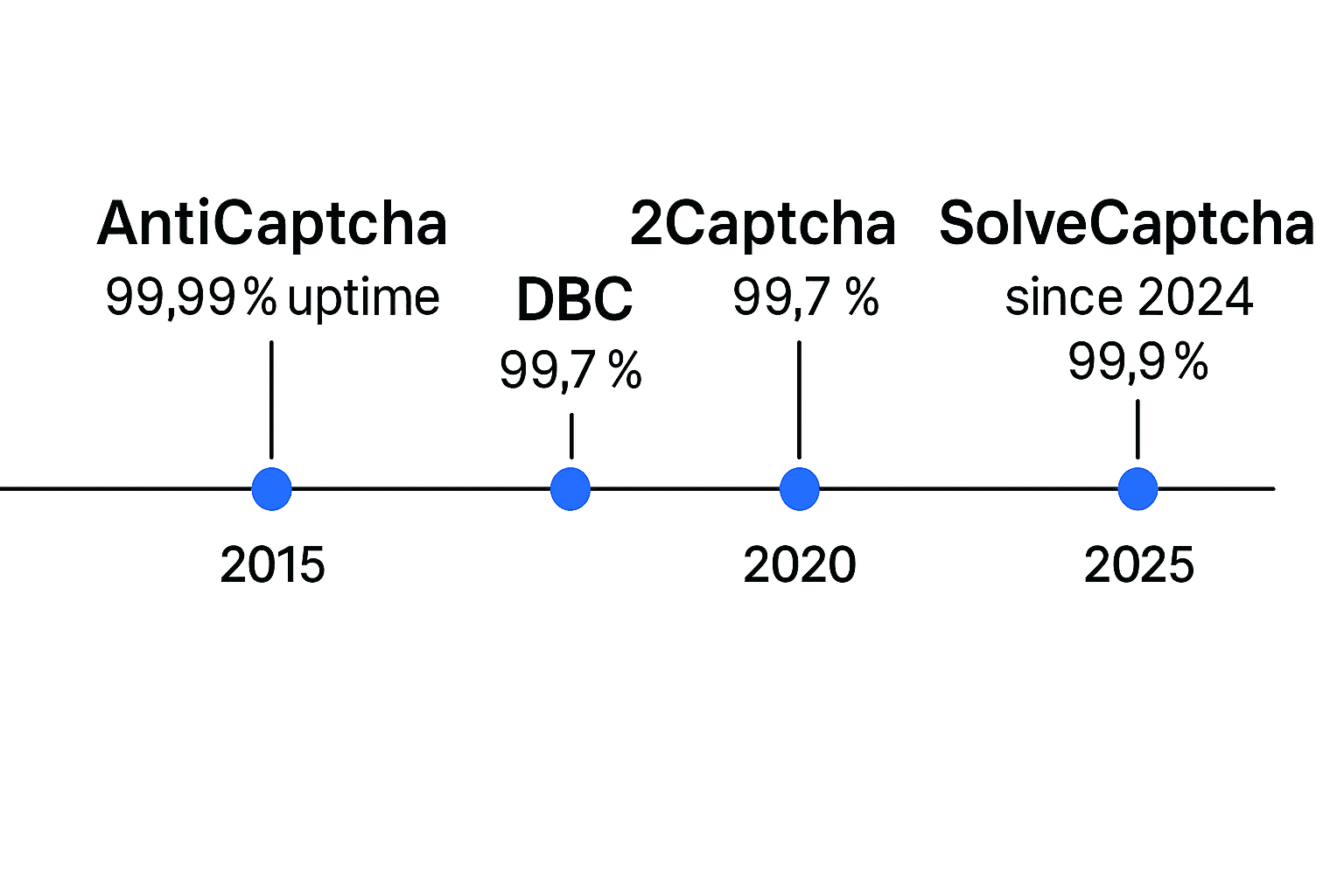
- AntiCaptcha advertises 99.99 % uptime since 2007—optimistic, though major outages have been rare.
- 2Captcha experiences downtime only occasionally, typically triggered by changes on the CAPTCHA provider’s side rather than its own infra.
- DeathByCaptcha had historical pauses, but is generally solid today.
- SolveCaptcha, while new, has recorded no notable outages so far; the architecture is lightweight and monitored 24 / 7.
Because the 2Captcha-style protocol is almost an industry standard, you can hot-swap providers if one falters—handy insurance for mission-critical flows.
Developer Experience: Documentation, Tooling & Support
Interfaces & Dashboards
- AntiCaptcha & SolveCaptcha deliver modern SaaS dashboards with charts, logs and on-boarding hints.
- 2Captcha keeps a minimalist cabinet—spartan but quick.
- DeathByCaptcha offers a basic, functional console.
Browser extensions (2Captcha, SolveCaptcha, AntiCaptcha, DBC) are broadly similar: drop in an API key and CAPTCHAs auto-solve in the background.
Documentation & Samples
- 2Captcha & AntiCaptcha—exhaustive docs plus huge GitHub repos, FAQs, community Q&A. 2Captcha’s ecosystem benefits from ten years of Stack Overflow answers and blog posts.
- SolveCaptcha—young but thorough: interactive API docs, Selenium/Puppeteer guides, eight language SDKs.
- DeathByCaptcha—leaner docs, fewer examples, yet cross-protocol support means you can reuse guides for 2Captcha/AntiCaptcha almost verbatim.
Technical Support & Community
- 2Captcha—responsive ticket system; a large English-speaking community.
- SolveCaptcha—24 / 7 promise holds up; Telegram channel replies within an hour.
- AntiCaptcha—tickets exist, but anecdotal reports note curt replies in thornier cases.
- DeathByCaptcha—tickets/email only during business hours (U.S. time), which can be awkward across time zones.
Pricing
Prices are quoted per 1 000 solved CAPTCHAs; all use pay-as-you-go.
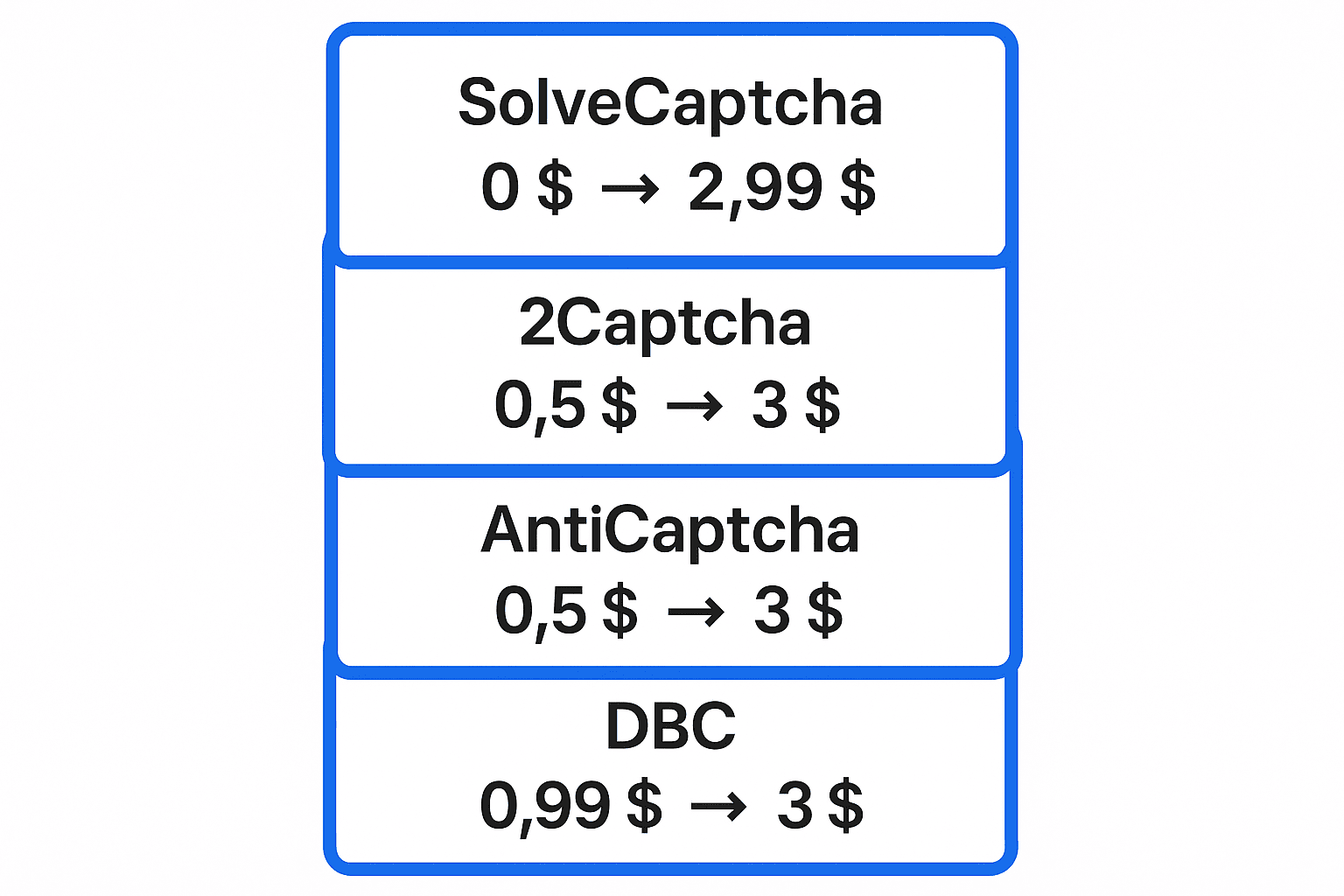
| Service | Simple images | reCAPTCHA v2 | Notes |
| 2Captcha | ≈ $0.50 | $1–3 | Dynamic pricing; very low floor. |
| SolveCaptcha | $0.50 | $0.55 | Promo-level rates; v3 ≈ $0.80, FunCaptcha ≈ $2.99. |
| AntiCaptcha | ≈ $0.50 | ≈ $1 | Dynamic; also offers monthly subscription bundles. |
| DeathByCaptcha | ≈ $0.99 | $1–3 | Peak-time surcharge possible; crypto discounts. |
All accept cards and crypto; 2Captcha adds regional methods (Qiwi, mobile top-ups).
So… Which Service Should You Pick?
- Choose 2Captcha if you value battle-tested reliability, enormous community resources and support for rare local CAPTCHAs. It’s the Swiss army knife of the field.
- Choose SolveCaptcha when raw speed matters most. Neural-net acceleration plus rock-bottom promo pricing make it the sprinter of the bunch.
- Choose AntiCaptcha for massive throughput, granular control and extra features (Custom Tasks, coordinate clicks, proxy targeting). Ideal for high-scale, complex workflows.
- Keep DeathByCaptcha in mind for API compatibility and hybrid OCR+human decoding. It’s a solid fallback if you already have legacy scripts or need audio CAPTCHA support.
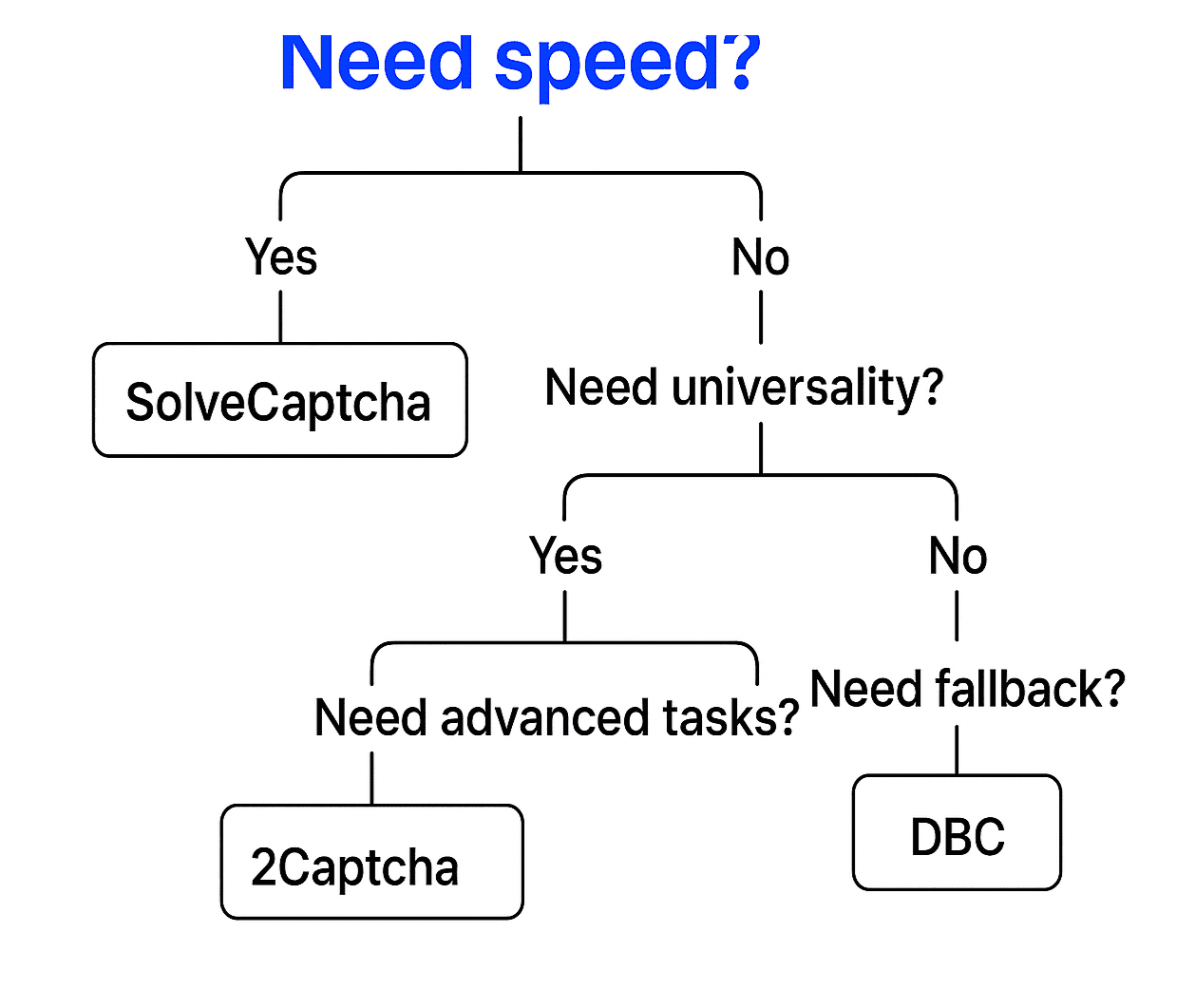
Many teams adopt a multi-provider strategy—try SolveCaptcha first; on timeout, failover to 2Captcha; hold DBC as tertiary backup. Because their protocols align, switching on the fly is straightforward.
Final Takeaway
CAPTCHA-solving platforms have evolved from simple “human farms” into sophisticated hybrids of human intelligence and machine learning. Our comparison shows that while baseline capabilities are similar—high accuracy, reasonable speed, developer-friendly APIs—the optimal choice hinges on your priorities:
- Speed critical → SolveCaptcha
- Universal coverage & community know-how → 2Captcha
- Enterprise-scale parallelism & advanced tasks → AntiCaptcha
- Cross-protocol flexibility & audio support → DeathByCaptcha
Testing two or more services against your specific CAPTCHA type and traffic pattern is the surest way to lock in performance, cost and reliability for your automation stack.